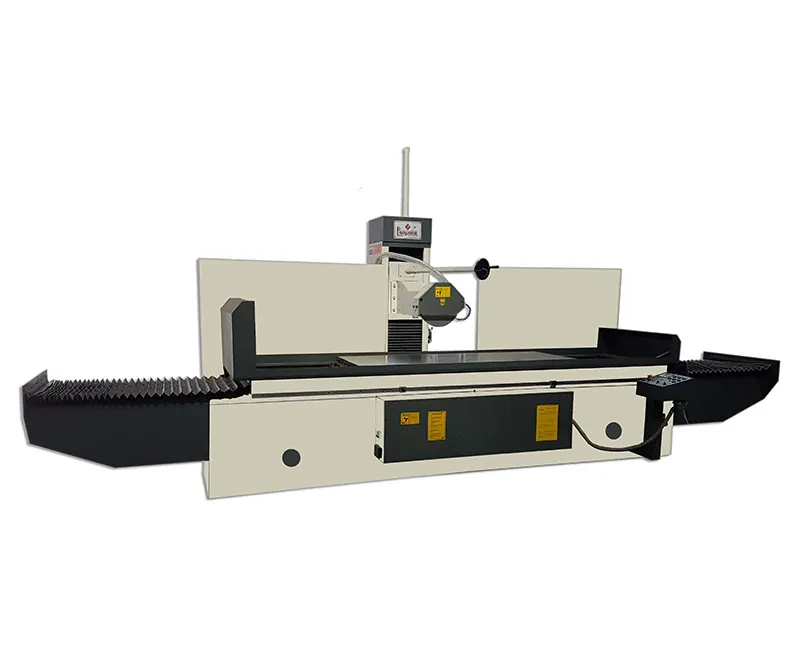
Milling removes metal fast. Grinding brings the part to its final quality. These are the main advantages of a surface grinding machine.
Fine size control
Depth steps of 0.002 mm (PH hydraulic) or 0.001 mm (double column CNC) let you finish parts to tight thickness tolerances.
Better finish
A dressed abrasive wheel gives a smoother, more uniform finish than a cutting tool.
Works on hardened steel
Grinding cuts heat-treated tool steels, so parts are finished after hardening, with no distortion left over.
Flatness and parallelism
A reciprocating table and magnetic chuck produce true datum faces for the next operations.
Repeatability
PLC and CNC cycles grind every part of a batch to the same size.
Versatility
With dressing, the same machine grinds flats, steps, slots, angles and profiles.
Advantages by type
- Hydraulic: smooth table, simple upkeep, good value. Oil type explained
- PLC: automatic down feed for batch output. PLC series
- CNC: profiles and dressing compensation. CNC range
- Double column: huge work in one setup. Double column
Frequently asked questions
Why grind instead of mill a flat surface?
For tighter size control, a better finish and the ability to work on hardened steel.
Are CNC surface grinders worth it?
Yes, for repeat batches and profiles. For one-off toolroom work, a hydraulic machine is usually enough.
