
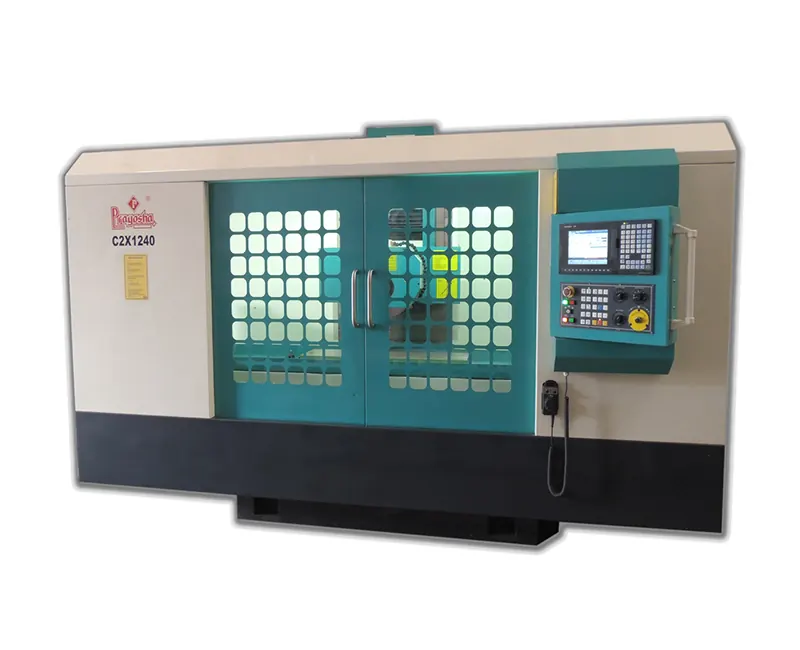
A surface grinder has a short list of jobs. It does each one very accurately.
| Function | What it means | Controlled by |
|---|---|---|
| Sizing | Bringing thickness to a tolerance | Vertical feed (0.002 mm least count on PH series) |
| Flatness | Removing bow and twist | Table and guideway geometry, chuck condition |
| Parallelism | Making two faces parallel | Grinding both sides alternately on a true chuck |
| Surface finish | Smooth, uniform texture | Wheel grade, dressing, coolant, fine cross feed |
| Squareness | Faces at 90° to each other | Angle plates, vises, vertical head (double column) |
| Steps and slots | Shoulders and grooves | Plunge grinding, dressed wheel |
| Profiles | Radii, angles, forms | Profile dressing and CNC control |
Supporting functions
- Automatic cross feed: 0.5–5 mm per reversal on PH machines
- Rapid positioning: moves the table and cross slide quickly between cuts
- Automatic dressing with compensation: keeps CNC batches on size
- Coolant filtration: keeps the finish clean over long runs
See also what a surface grinding machine is and the full specifications.
Frequently asked questions
What is the main function of a surface grinding machine?
To produce flat surfaces at accurate size, with a good finish.
Can a surface grinder make profiles?
Yes. With a dressed wheel, especially on a CNC machine with profile dressing.
